Every answer carries its source, or there is no answer.
The citation guard is the product. This page sets out how it works, what we have measured, and the things juris will not do.
The citation guard
Every claim is checked against the retrieved source before you see it, and the result is shown rather than hidden.
The cited passage was retrieved and supports the claim. This is the only state that should carry weight.
The source mentions the citation but is not itself the authority for it. Useful for following a chain, not for relying on.
The citation could not be matched to a retrieved source. It is marked, never quietly removed, so you can see the gap.
Colour is never the only signal: each state also carries its own glyph, so the distinction survives a monochrome print and a colour vision deficiency.
Refusing is a feature, not a failure
When the corpus does not support a precise answer, juris says so. A confident-sounding answer with nothing under it is the specific failure mode that makes legal AI unusable, and refusing is the only honest response to a question the sources cannot carry.
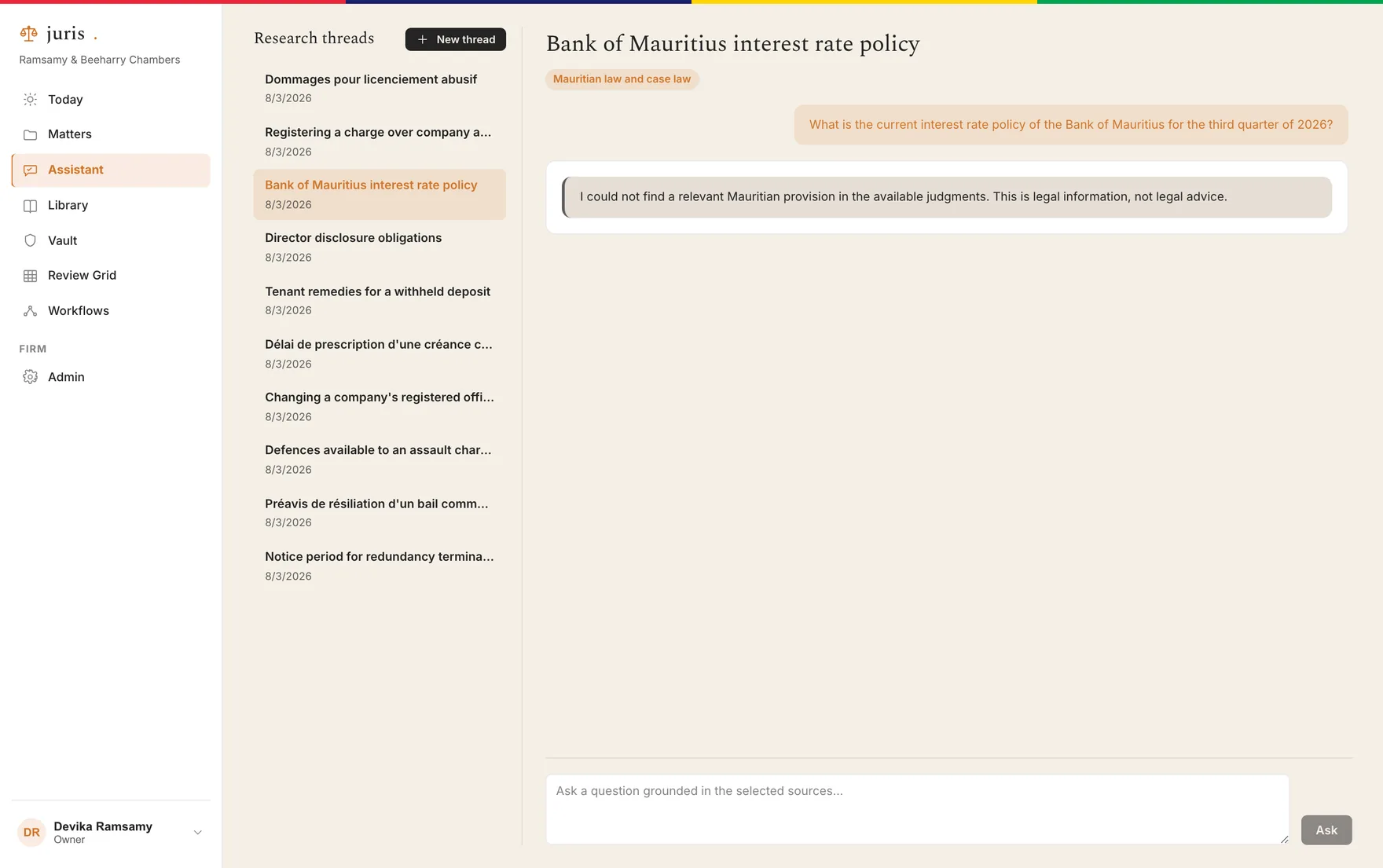
Citation health is visible to the firm
Your administrators can see the split between verified, cross-referenced and unverified citations over time, across the whole firm. If grounding quality moves, you find out from your own console rather than from us.
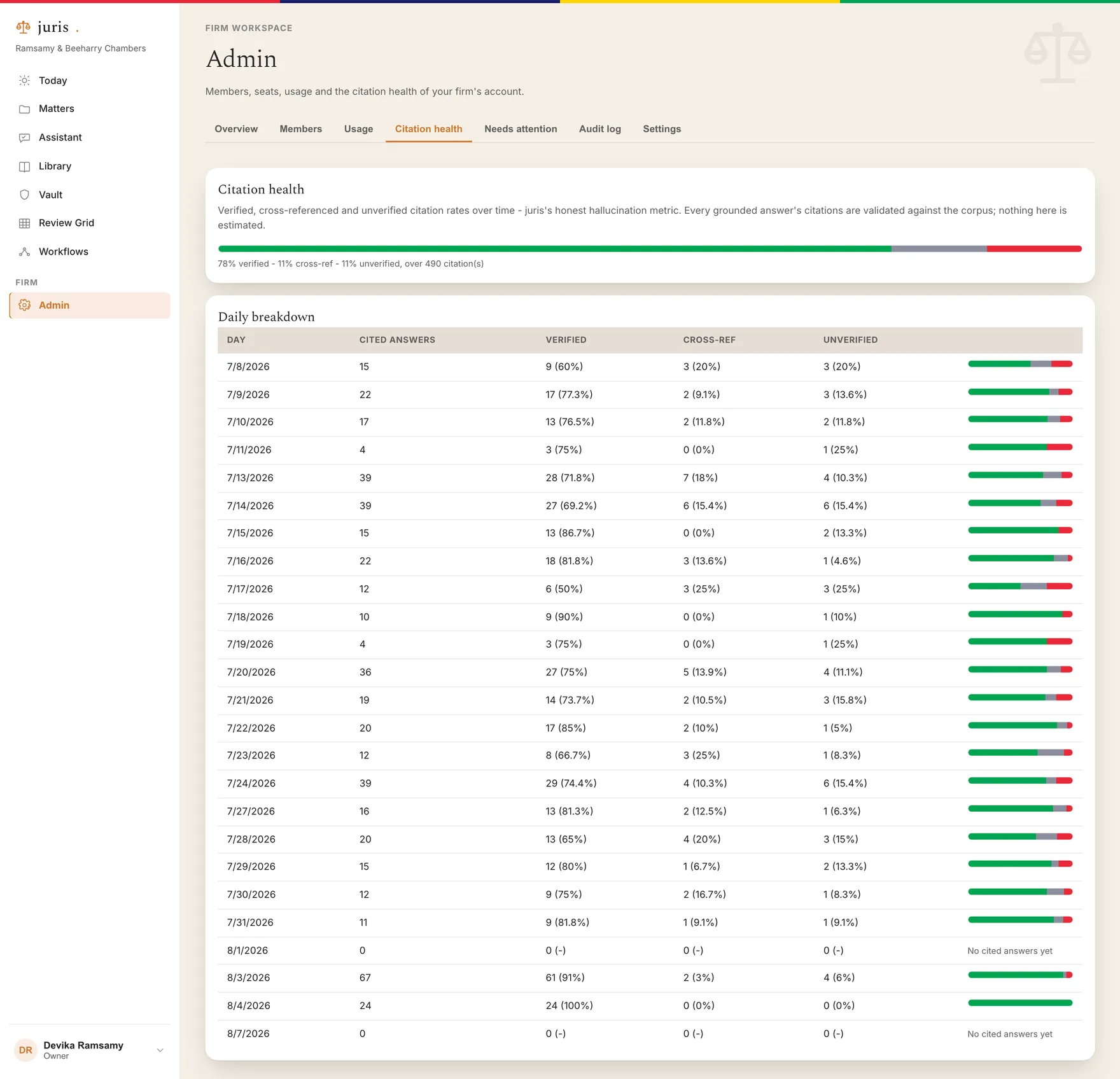
Screens throughout this site show a demo firm with illustrative matters. The legislation and judgments cited are real.
What we have measured
A gold set of 43 real questions with known correct sources, run through the actual production retrieval path. Every stratum, not only the flattering ones.
Case law and the French Codes are what a practitioner asks for, and they are where the system is strongest. The overall figure is lower because it includes plain-language and Kreol Morisien questions from the citizen surface, which are harder and which we are still improving. We publish both because a page that showed only the case-law number would be selecting its own evidence, and this product's whole claim is that it does not do that.
Scored with NDCG@10 and recall@k per stratum, against known-correct documents, on the live retrieval stack (voyage-4-large embeddings with Voyage rerank-2.5). The method and the raw results live in the evaluation set behind the product, not in a slide.
What it is not
It does not predict outcomes
juris never expresses a probability of winning or losing, and never tells you how a court is likely to decide. The corpus carries no outcome labels, so any such number would be invented. A separate check strips prediction language from every answer before it is shown, on every surface, for every audience.
It does not give legal advice
Under the Law Practitioners Act 1984, only a person on the Roll may give legal advice or act in a matter. juris does neither. It retrieves, answers from what it retrieved, cites it, and refuses where the sources do not support a precise answer. The instructing practitioner remains of record for every matter run through it.
Questions practitioners ask
What is actually in the corpus?
What happens when a citation cannot be verified?
Is our matter data used to train anything?
Can it draft?
Talk to us about your firm
There is no self-serve signup. Every engagement starts with a conversation about your firm's matters and how the back office should be set up for you.